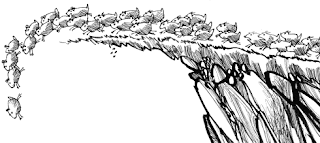
I first posted this piece on March 15, 2020. We lost Dick Fosbury recently, so I am reposting in his honor. There are very few "singularities" in sports, a moment when there is a clear before and after. Babe Ruth's home runs. Seth Curry's 3-point shooting. Dick Fosbury's Flop. RIP.
Remember Dick Fosbury? In 1967 he was ranked the 61st best high-jumper in the
world. At the Olympics in Mexico City
the following year, he cleared the bar at 7 feet 4.25 inches and won the gold
medal.
He did it with a style so
different from the traditional "western straddle" that it came to be called the Fosbury Flop. People laughed. Coaches watched in
disbelief. One newspaper described it as
going over the bar "like a guy being pushed out of a 30-story window."
Today, you cannot find a world-class high jumper who doesn't
do the Fosbury Flop. One moment it was
one thing; the next, it would never be the same.
It's the 50th anniversary of a string of albums that have made up about half of my listening over the last 50 years. I doubt that fact reflects well on me, but I don't care. I'm now at a place in life where an artist can receive a Grammy for "Lifetime Achievement," and I have not heard any of his or her music. Not a song. Can you hear me, Dr. Wu? I. don't. care. :) Forthwith, my tongue-in-cheek tribute to the music of my life.
+++++++++++++++++++++++
Nothing much had happened in the music world before the spring
of 1969.
A bunch of guys with long hair fiddled around with harpsichords sometime
between Rome and the steam engine. And then a bunch of guys with beards fiddled
around with saxophones. I think some guys with guitars sang. Something like
that.
Anyway, music was invented on April 4, 1969 when a band
called the Chicago Transit Authority released its first album.
There followed a flood that barely lasted a decade. Nothing
much has happened since 1979—since September 24, 1979, to be exact, when the Eagles
released The Long Run.
Dave grew up outside Pittsburgh and studied Chemistry at the University of Pittsburgh. His name is inscribed in the Omicron Delta Kappa Walk, a stone path between the Cathedral of Learning and Heinz Chapel, in honor of being named Senior of the Year in 1979.
I had the great misfortune to meet Dave when Pitt won the national championship, the Pirates won the World Series, and the Steelers won the Super Bowl. All at once. He was humble and softspoken, but not about his "City of Champions."
We roomed together in Brooklyn Heights, and both worked our first "real" jobs for the Chase Manhattan Bank, taking the subway each morning under the East River to the basement of Chase Manhattan Plaza. Our training floor included 200 recent college grads from all over the country, and we fell in with a great group of friends whose mission was to discover Manhattan.
Since many of our colleagues lived on the Upper West Side, Dave decided that he and I had to purchase "crazy hats" so we could ride the 7th Avenue Line without trouble in the wee hours of the morning back to Brooklyn Heights. "Wear it low, look crazy, and never make eye contact," he told me. Good advice.
We thought it would be fun to celebrate New Year's Eve 1980 in Times Square. We donned our crazy hats and headed into (what was then) a cesspool, watching as a gang of thugs at the edge of Dick Clark's Rockin' New Year's Eve television lights cornered people and stole their wallets. Interested only in cash, the gang grabbed the bills and dumped each wallet in the trash. Dave and I went fishing, and on the morning of January 3, 1981, we mailed 15 wallets full of driver's licenses and credit cards back to their owners all around the country.
Dave invited me home the first Thanksgiving we roomed to meet his family. His mother served a vast, delicious Italian meal, and I remember thinking, "This is nice but unusual for Thanksgiving." Then Dave's mom cleared the table and served an entire traditional Thanksgiving turkey meal. He just looked at me and said, "Now you know why I have trouble losing weight."
I roomed with Dave during our first year at Harvard Business School. He introduced me to the HP-12C, chocolate-covered pretzels, and Cotton Eye Joe. He convinced me that Harry Truman was the only person in history who could have taken over the world. Based on his obsession with Louis L'Amour novels, he warned me never to carry a knife unless I was prepared to use it. More good advice.
Dave was the best man at Sue and my wedding in 1984 and godfather to our Emily.
A frozen moment, frozen in time
In the time I knew David Rossi, all he ever really wanted to do was go into space. He might have been an astronaut, except for his poor eyesight. Between senior positions at Spacehab and Orbital Sciences, he got close. Even when the Space Shuttle Columbia disintegrated as Dave lay dying of cancer, he never lost his optimism or passion for the final frontier.
At Dave's funeral in Washington, D.C., six of us were asked to speak.
As we chatted beforehand, I realized we all believed the same thing: David Rossi was our best friend.
We were all correct.
Only the good die young. 20 years ago and still with us. Rest in peace, my friend.
As I recuperate from recent surgery, still too green around the gills to research and write an entirely new blog post, I'm re-upping this post from August 2016. I will never again take the luxury of feeling good for granted.
(August 2016) A few weeks ago I took an Amtrak round-trip to New York City. I enjoy riding the train, which gives me four undisturbed hours each way to work. On this particular day, however, I was feeling just a wee bit green, like that time I should have gotten off the sailboat 15 minutes earlier than I did.
I knew I was in trouble when I opened my iPad and tried to read. A little rumbly. A little hazy. A little green. I closed the cover, and my eyes, and thought happy thoughts.
Maybe it was too much sun the day before, or maybe something I ate. Maybe it was simply the human condition. Whatever the case, I was just slightly off my game that day—not too sick to cancel the trip, but not quite well enough to be comfortable and productive.
There exists in our modern world the presumption--or maybe better--the luxury of feeling good. Some combination of healthy food, enough sleep, exercise, aspirin, and access to real medical care when required have been foundational to my decades in the workforce. Yours too, undoubtedly. I know there are unfortunate people who suffer without relief, but most of my co-workers through the years have been able to function comfortably on a daily basis thanks to the many blessings of modern life, from coffee to cold packs to dentists to Tylenol, that keep us upright and productive.
What makes the luxury of feeling good so special is that we are among the very first generations of humankind to expect each day to be pain-free and generally comfortable.
I originally posted this short essay in 2009 but dusted it off last night after I received an email from a friend. He wondered if people really understand what it means to "flatten the curve" of the Coronavirus outbreak. If successful, fewer of us will get sick, hospitals will be less overwhelmed, and fewer of us will die. That scenario is the win. Victory, however, leaves more of us who have not contracted the virus. No "herd immunity." Ongoing anxiety for the healthy and well. "We won't have a vaccine for another year," he wrote."If we go back to 'normal' once the curve is flattened, the rate at which the virus spreads will simply accelerate again. I can't understand why our leaders are setting expectations that we'll be back to normal in a couple of months. From my perspective, we're going to have to practice physical distancing for another year unless we find an effective cure, can manufacture it in large quantities, and distribute it so that it's immediately available to everyone who needs it . . . Am I missing something here?" I first encountered this phenomenon, where logic speaks one truth but authority another, circa 1973. I still remember the class like it was yesterday.
++++++++++++++++++++++++
In my sophomore year in high school, we took a class called Political Ideology.It was taught by a terrific teacher, Orin Holmes, who announced on the first day of class that if we “played school” with him we would flunk. Nobody was quite sure what that meant, but we were game.
About a month later, we walked into class and found that Mr. Holmes had projected on a screen an ancient Greek building with impressive columns.He explained that the Greeks were experts in perspective and had, with this building, bowed the columns (that is, made them fat in the middle, tapered at the ends) to create the illusion that they were perfectly straight.
“See,” Mr. Holmes explained, “how they are tapered to look straight?”
We all shook our heads. Yes, of course, the Greeks were brilliant.
He tried again.“See the bow?See how it makes them look perfectly straight?”
Again, a great bobbing of heads.
Finally, he turned off the projector, clearly distressed.“Does anyone see the problem?”
There was silence. Problem?The Greeks.Columns.Perspective.Bowed.Straight. We got it. What problem?
Then Mr. Holmes said, “If I don’t teach you anything else this year, I want to teach you to think for yourself--to take an independent point of view.If I tell you something is straight, and it looks bowed, you should say something like, ‘Mr. Holmes, the Greeks blew it.They didn’t understand perspective all that well, because they bowed the columns to make them look straight--and they look bowed.I see it with my own eyes.’”
We all hung our heads.We’d been busted playing school.
In 1721, minister
Cotton Mather took to the streets of Boston during a smallpox epidemic to
collect data that would prove his theory that inoculation was far less deadly
than catching the virus naturally.
Mather
understood intuitively what future thinkers like Peter Drucker would one day
preach: You can’t manage what you don’t measure.
America's first permanent head of the nation's census office divided all of history into two periods: superstition and statistics.
The ability of
Americans to take a vast trove of data and turn it into useful information resulted
in the creation of what Daniel Boorstin called “statistical communities.”Examples from his Pulitzer-prize winning
book, The Americans: The Democratic Experience, include:
This post was first published in November 2009. I tried this week, in the midst of the pandemic, to schedule Peapod delivery. It was booked solid. For weeks.
When I was a kid, we had a milkman.Johnny the Milkman.We’d spot him making a delivery and run to meet his truck.Johnny the Milkman had a great boxy vehicle without passenger seats. Both sliding doors were left open to catch the summer breeze. A huge block of ice sat melting in the middle of the truck’s floor, meant to keep the glass bottles of milk and cream cold.
In the days before OSHA and seatbelts and common sense, Johnny the Milkman would let us jump on board and dangle our arms and legs out the passenger door for a few stops, dragging our Keds on the road as we drove from house to house.Then, to complete the nightmare for our mothers, he’d give us an ice pick and we’d stand on the slippery floor to chip off a handful of cold, crunchy microbes to chew on.
There's nothing that says nostalgia like a seven-year-old with an ice pick, dangling his legs out of a moving truck full of loose glass bottles, sucking on dirty ice.
One of the most famous motivational stories on the entrepreneurial circuit is that of the two salesmen from competing companies who are sent to a foreign country to assess the market for shoes.
Salesman One scouts around for a few days and then heads for the telegraph office to contact company headquarters. He writes: "Research complete. Unmitigated disaster. Nobody here wears shoes."
Likewise, Salesman Two does his research and heads for the same telegraph office. Once there, he composes the following: "Research complete. Glorious opportunity! Nobody here wears shoes!"
The point, of course, is that Salesman Two is the real entrepreneur, the person who sees opportunity where others do not. It's a story designed to motivate us all to find hidden potential, take risks, and turn obstacles into opportunities.
The question is: Should we bite? Does fate reward the visionary risk-taker?
In the spirit of Apocrypha, it seems there's more to the story of the two salesmen. Last year, a librarian at the BritishMuseum discovered a short manuscript in a long-forgotten file.
Why I Love John McPhee #1, on Sophia Loren: “Her feet are too big. Her nose is too long. Her teeth are uneven. She has the neck, as one of her rivals has put it, of 'a Neapolitan giraffe.' Her waist seems to begin in the middle of her thighs, and she has big, half-bushel hips. She runs like a fullback. Her hands are huge. Her forehead is low. Her mouth is too large. And, mamma mia, she is absolutely gorgeous.”
++++++++++++++++++++
Two guys ski down a mountain side-by-side.Both are 50 and fit.Both have good form. Both are going like bats out of heck. Neither falls.And yet, one learned to ski when he was three years old, the other at 35-years-old.
And. you. can. tell. the. difference.
It’s the same with golf, the same with tennis. Learn late and you can never really catch up.
Ever drive with someone who got his license after age 40?If so, you may still be waiting for
the right moment to enter the rotary.
And thus it is with writing.Malcolm Gladwell wrote for newspapers out of
college, including ten years with The Washington Post and, since 1996, The
New Yorker.Can you tell?Stephen King sold his first story as a
sophomore in college. Stephen Sondheim
was mentored at age ten by Oscar Hammerstein and, by 22, had written four
Broadway shows under Hammerstein’s tutelage.
And John McPhee, one of my favorite non-fiction authors, began with Time
magazine out of college and moved to The New Yorker, all the while
writing Pulitzer-Prize winning books.
For those of us who came to writing late in life, there is
no catching up.We may ski down the
mountain without breaking a bone, but you. can. tell. the. difference.
So, when I discovered free advice being offered by Prof. McPhee
in his Draft No. 4, I gladly accepted.
Sometime in the 1930s astronomers observed a phenomenon they could not explain. Clusters of galaxies were moving in ways that made no sense based on what could be seen. There had to be more mass “out there” holding things together--more gravity slowing down the expansion of the universe.
This was the first inkling of something called dark matter.
In 1998, scientists pointed the Hubble Telescope at distant supernovae and found, contrary to expectations, that the expansion of the galaxy was actually accelerating. Alongside all that dark matter, there must be some other force at work, a kind of dark energy.
Today, scientists believe that dark energy and dark matter make up almost everything. What can be seen, what we used to believe was our entire universe, is less than 5% of what's really out there. “Eliminate all other factors," Sherlock Holmes advised, "and the one which remains must be the truth.” Even if it’s invisible. Even if nobody quite knows what it is.
In 1883, Henry Ford was tinkering with a neighbor’s watch and claimed later to realize that it could be manufactured for thirty cents. He never pursued his idea, however, concluding that “watches were not universal necessities, and therefore people would generally not buy them.”
Ford was a brilliant entrepreneur but missed “the watch thing.”
IBM was the second most profitable company in the world and probably the smartest technology company when it missed “the desktop thing.” Microsoft completely whiffed on "the search thing, “the cloud thing," and, as Steve Ballmer once disclosed, the "phone thing."
Really smart people and killer organizations miss enormous opportunities, even when those organizations have their eyes wide open and antenna fully extended.
Mine begins with Ray Charles singing Hit the Road Jack as my mother drove me to preschool. The junior-high summer I broke my leg is Three Dog Night's Joy to the World. America's Sister Golden Hair was playing the night of my high school graduation, and Steely Dan's My Old School was cranked up as I stacked my dirty laundry against the screen of my Brown University dorm room, hoping a fresh breeze would save me a trip to the basement laundry for another week.
The summer I interned for Susquehanna Broadcasting it was Eye of the Tiger, and the year I met my wife was The Police's Synchronicity, an album that featured both Wrapped Around Your Finger and (he noted) Murder By Numbers.
Last year, Apple announced it was sunsetting iTunes, but not before the global community had downloaded 26 billion songs. And now we're all streaming and building algorithmically-inspired mixtapes.
Somewhere in there, you've acquired your own soundtrack, too.
(No STEM majors were harmed in the writing of this post.)
History is in a bad way.
A poll conducted in 2018 revealed that only one in three
Americans could pass a U.S. Citizenship Test.A similar percentage believed Ben Franklin invented the lightbulb.Twelve percent thought Dwight Eisenhower led
troops in the Civil War.
First, a confession. I never really got Mister Rogers, at least while he was performing in his children’s television show. Maybe it’s because I was very young when PBS, in the guise of its predecessor (NET), was still a primordial ooze of Physics professors writing long equations on chalkboards, grainy British programming, and a cooking show where a quirky lady taught viewers how to turn a calf’s foot into aspic.
When Mister Rogers launched in 1966, it took a while to understand that he was something different and, once paired with Sesame Street in late 1969, something better for children to watch than Soupy Sales or Bozo. By then I had outgrown my Mister Rogers moment, so only later did I come to appreciate who Fred Rogers (1928-2003) was and his impact on so many people. Now, after reading Maxwell King’s The Good Neighbor: The Life and Work of Fred Rogers (Abrams Press, 2018), I have come to understand that we need people like Fred Rogers more than ever.
A few hundred yards along Stone Avenue, just off Chambersburg
Road on the Gettysburg battlefield, stands a six-foot-high bronze statue dedicated
to John Burns (1793-1872).The
inscription includes a report from Major General Abner Doubleday, who wrote that
Burns, though seventy years of age and a civilian, "shouldered his musket
and offered his services" on the first day of the battle, joining the
skirmish line of the 150th Pennsylvania Volunteers.When the 150th retired from the field, Burns fought
alongside the Iron Brigade in some of day one's most intensive action.He was wounded three times and carried home to
recover.
John Burns was a veteran of the War of 1812.Neither this prior service nor his advanced age
mattered when the Civil War invaded Gettysburg.As gunfire erupted, he grabbed his ancient flintlock and powder horn,
more Ichabod Crane in his "swallow tail" coat and black silk hat than
Johnny Yank.Insisting to Union
commanders that he knew how to shoot, this citizen-warrior was provided a
modern rifle and traded fire bravely with Confederates until he could no longer
stand.
What would possess a 70-year-old veteran to put his life on
the line? Perhaps Burns recognized that the single greatest fight of his life,
to preserve the American union, had begun.It did not matter if he had already served his country.It did not matter that he was entering his
seventh decade of life. Burns opened his door, listened for the gunfire, and then
walked toward the battle.
Bert is 72, a Baby Boomer, and lives on the East Coast. He is mostly retired after a successful career in consumer marketing, including running his own successful business.Bert is technically savvy and aware, and usually has the latest i-Gizmo.
Ernie is in his early 40s, a Gen Xer, and lives on the West Coast. He teaches at a private boys’ school. He’s a runner, and a good one, not to mention being an enthusiastic and fearless early-adopter of technology.
In February, I wrote a post comparing tech giants of the twenty-first century to those of the nineteenth century (see here). I wondered in the post if maybe historian Richard Hofstadter had been correct when he wrote, "Once great men created fortunes; today a great system creates fortunate men."
That’s when Ernie dropped me a note from Oakland. It was clear I wasn’t seeing the modern digital landscape clearly. Here’s what he wrote:
At the start of 2017 I checked the actuarial tables and determined, at 12 books per year, I had about 168 books left to read. Give or take. That's not a lot. So I decided then and there that I would read only books that had the potential to change my mind, or change my life.
Yuval Harari's Sapiens is one of them, not only because it's as absorbing as a novel, but I now believe it explains nearly everything that has confused me about life and my fellow human beings since November 2016.
Some say the world will end in fire,
Some say in ice.
Yet as for ocean ships that ply
On frigid seas where icebergs lie
If we insist they perish twice
I think we know enough of steam
To say that for destruction fire
Is also great
And plenty dire.
A friend of mine who works in non-profit fundraising says the best way to learn about a person is to ask about his or her top three charities. Once someone reveals where they freely and enthusiastically give their money, you can quickly understand what makes them tick.
Pulitzer Prize-winning historian Gary Wills has another way of sizing up people. "Show me your leader," Wills wrote in Certain Trumpets," and you have bared your soul."
Willis offered his book about leadership in 1994, a year brimming with leadership advice. John Maxwell offered Developing the Leader Within You and Leadership 101. Stephen Covey was flogging Principle-Centered Leadership. Max DePree's Leadership As An Art was selling well. Warren Bennis's On Becoming a Leader drew on hundreds of interviews to try to define the inner qualities of leadership. And, after 450 years, Machiavelli's The Prince--"it is much safer to be feared than loved"--still had its enthusiastic disciples.
Wills boiled the existing literature down to the description of two types of leaders. The first was the "superior-person" model which said the leader must become worthy of being followed. The second was the "ingratiating" leader who treated followers as customers that must be won and influenced. "We have long lists of the leader's requisites," Wills wrote, including "determination, focus, a clear goal, a sense of priorities, and so on. We easily forget the first and all-encompassing need. The leader most needs followers."
If you are interested in hiking Dogtown, see here.
Gloucester, Massachusetts, is a beautiful fishing and summer
community located on Cape Ann, adjacent to the town of Rockport.
Nested
away from the shoreline between the two towns is an ancient neighborhood of about
3,600 acres once called the Common Settlement, but known today as Dogtown. At the time of the American Revolution, the
Common Settlement was one of the town’s most prosperous areas, home to about
100 families.
After the War of 1812, however, farmers seeking less rocky soil and
residents desiring homes along now-peaceful beaches began to depart from the area. The neighborhood gave way to the poor and
outcast, faithfully captured in Anita Diamant’s The Last Days of Dogtown. By
1830 the once prosperous area was abandoned, leaving behind old cellar holes and packs of feral, howling dogs.
Babson was an entrepreneur, investor,
naturalist, and historian.
During the Great Depression, Roger Babson (1875-1967),
founder of Babson College, commissioned unemployed Finnish stone-cutters to carve inspirational
inscriptions on some two dozen boulders spread throughout Dogtown. Babson's family, which owned the land, was entirely underwhelmed by the project. In 1935 he wrote:
Another thing I have been doing, which I hope will be
carried on after my death, is the carving of mottoes on the boulders at
Dogtown, Gloucester, Massachusetts. My family says that I am defacing the
boulders and disgracing the family with these inscriptions, but the work gives
me a lot of satisfaction, fresh air, exercise and sunshine. I am really trying
to write a simple book with words carved in stone instead of printed paper.
Today, Dogtown is dense woodland crisscrossed by hiking
trails. Dogtown Road is still the main thoroughfare
and features the remains of cellar holes.
And, like tweets left by a retreating glacier, Babson’s
wisdom remains. Some of the inscriptions are universal. Some are quaint. Some may have been tongue-in-cheek. But for the stonecutters who needed the work, they must have been a godsend. And for those who hike the area (as I did a
few weekends ago), seeking out these boulders is like an Easter egg hunt.
These three inscriptions will give you the general drift, as well as an idea of Babson's sense of humor: