Tuesday, August 4, 2026

Reimaging King Philip's War on Its 350th Anniversary


Please check out the Old Colony Museum's blog on Medium for my newest piece on King Philip's War. Much excellent history has been published since Mike Tougias and I wrote our book in 1999. The image of Metacom has continued to evolve. The 350th commemoration of the War is a good time to "sum up" what's happened in the last generation.

And please be sure to join Pokanoket Tribal Historian Strong Turtle and me "in conversation" at the Old Colony Museum on 8/25 at 6 p.m.


Tuesday, November 4, 2025

From Dighton to Vietnam: Chatting with Dr. Andrew C. Carr About "The 8th Field Hospital"

The original version of this post, one of my favorites in the last few years, is on the Old Colony History Museum's "Medium" blog here. Please take a look. Every reader gets "50 claps" on Medium, and the more claps, the more a post is promoted. So, please clap away!

I am thankful to Dr. Andrew "Andy" Carr for his willingness to be interviewed, to his kind and talented wife, Roberta, for her support, and to Gil Garnet for his deep knowledge of our hometown.

My family moved to North Dighton in 1959 when Raytheon occupied the former Mount Hope Finishing Company's facility on Spring Street. For many of us in North Dighton--a bit like the East and West Boxford(s), where I live now--there were two towns. One stopped on Somerset Avenue at the Elementary School; beyond that, "there be dragons." For the other half of the town, the "real" Dighton didn't begin until the Elementary School. This geographic spread was the source of tension during the Mount Hope years and (I suspect) remains so today. (A little bit, as I said, like East and West Boxford.)

Hearing Dr. Carr's story was not just about a wise and compassionate physician, but also great fun for me to learn about the Dighton of the 1940s and 50s — the "other" Dighton — and to recognize some of the enormous talent that our little town has generated over the years.

Of course, Dr. Carr attended school for many years in the building that we knew as the Raposa-Knott VFW--across the street from my home, and the best way to "The Peat" where we skated and learned to play hockey.

Bird's Eye view of Pearl Street, stretching off toward "The Peat." In about 1992 (before drones), I took a plane ride to take aerial photos of Anawan Rock and the Great Swamp Fight marker for research on King Philip's War.

Mount Hope's view of North Dighton from the opposite perspective. I devoted a chapter to JK Milliken and his company in my book Innovation on Tap. I also wrote a blog post about North Dighton in 2013, which can be found here.


Several views of Andy's old North Dighton Grammar School, "the VFW," now a private residence.

Anyway, before I head down the rabbit hole completely, take a look at the Old Colony post on Medium. You'll love Andy's story. And when you're on Amazon purchasing his book (or visiting Old Colony, which has also stocked copies), take a look at Roberta's novels. The one I chose, The Vernazza Effect, is based on the relationship between Roberta and Andy. As I told Roberta, I was impressed by Andy after reading his book and interviewing him; I was even more impressed after reading her novel!


Thanks again to Andy, Roberta, and Gil for their support, and to Old Colony for keeping history alive. And wishing Dr. Carr many more years of good health and great storytelling.


Thursday, July 17, 2025

"Innovation on Tap" Excerpt # 9: Willis Carrier, Entrepreneur (119 Years Later)

[Redux from July 17, 2021:] The seventh chapter of "Innovation on Tap" is the story of entrepreneur Willis Carrier and the birth of modern air conditioning, which celebrates its 119th anniversary today. The excerpt below moves the story ahead some 13 years, to the launch of Carrier Engineering Corporation as a standalone company by Willis and his partner, J.I. Lyle.

While we think of HVAC today as a multi-billion dollar, global, growth industry, the story of Carrier’s launch—in the teeth of World War I, when global trade had ground to a halt--reminds us of just how nimble, innovative, and entrepreneurial Willis and his partners had to be to succeed. 

For more on Carrier and its storied history, see here.

++++++++++++++++++++++++++++++++

Carrier Engineering Corporation (CEC) opened for business on July 1, 1915. It was a classic start-up. Willis Carrier rented two rooms in the Mutual Life Building in Buffalo for himself, a secretary, and one draftsman. “We ended up with second-hand furniture—two desks, a drafting board and stool and a few files," his secretary recalled. "We had two wicker chairs for visitors, and Mr. Carrier’s friends would ask him if he had swiped them from a tavern.”


Carrier Engineering raised enough cash to run the business for six months without a sale. "This was certainly cutting it pretty fine," Willis recalled. And, for eighteen days, the new company languished. But what World War I had taken away, it suddenly returned. 

Saturday, April 5, 2025

Genealogy and Potatoes Redux: In Praise of American Ancestors’ New Family Heritage Experience

The facade of American Ancestors'
about-to-open 
Center for Family History,
Heritage & Culture 

I had the opportunity last week to visit Ryan Woods, the President of American Ancestors, at the organization's home office, the New England Historic Genealogical Society, on Newbury Street in Boston. Ryan and his team are scheduled to cut the ribbon on the new, very cool American Ancestors National Center for Family History, Heritage & Culture at 97 Newbury Street on April 24th. 

This spectacular new center is part of a multi-structure building complex named after American philanthropist and preservationist Thomas Bailey Hagen and Harvard Professor Henry Louis Gates, Jr. The center will house the Brim-DeForest Library, R. Stanton Avery Special Collections, the Wyner Family Jewish Heritage Center, the Brue Family Learning Center, museum store, staff offices, and the Family Heritage Experience—an interactive museum experience that will introduce visitors to the joys and possibilities of family history

Acquiring the building next door to NEHGS’s long-time library was an opportunity that first presented itself in 2012, the final year of my term as Chair of the organization. The owner of John Lewis Jewelers paid a visit and led us on a tour. Now, after much planning, fundraising, and hard work, the center has been conceived and is (nearly) completed.

The new entrance to the Center is top left followed clockwise by the facade in 2011, showing the old John Lewis
Jewelers; below, our friends the Kyles admiring the design in 2011, and (bottom right) Ken Burns speaking at the first fundraiser
for the Center that same event and year, 2011.

Ryan was kind enough to take me for a tour and even allowed me to snap a few pictures. I don’t want to (and can’t possibly) give everything away, but the Family Heritage Experience is destined to be a top 10 Trip Advisor recommendation in Boston, something full of fun and interactive activities.

Arrive at the Center and place yourself on the map--where you belong!

Pick a disc, scan the barcode on the back, and get started on your genealogical journey.


The famous, or infamous Shattuck family painting. Like our current administration, if you don't like history, you just make
it disappear. That bush in the middle used to be, well...


As we were talking, Ryan reminded me of a brief talk I gave in 2008 when I was elected Chair. The talk, which I had forgotten, compared genealogy and the potato. Fortunately, I found it buried on this blog. So, I dusted it off and present it here.

I hope it will help you imagine the new Family Heritage Experience as an Idaho Russet potato fired at 117 feet per second through a hose into a finely sharpened grate, coming out the other side in a perfect French fry cut.

Sunday, March 9, 2025

Mass Audubon Ocean State Weekend - March 1-2, 2025

I was fortunate to spend the weekend of March 1st and 2nd with a great group of Mass Audubon birders visiting sites throughout Rhode Island. Day one included locations on Aquidneck Island, including Portsmouth, Middletown, and Newport. The Ebird hotspots were Town Pond, Lawton Valley Reservoir, Sisson Pond, and Sandy Point Beach. These sites featured dabbling and diving ducks of all shapes and sizes, fresh and saltwater.

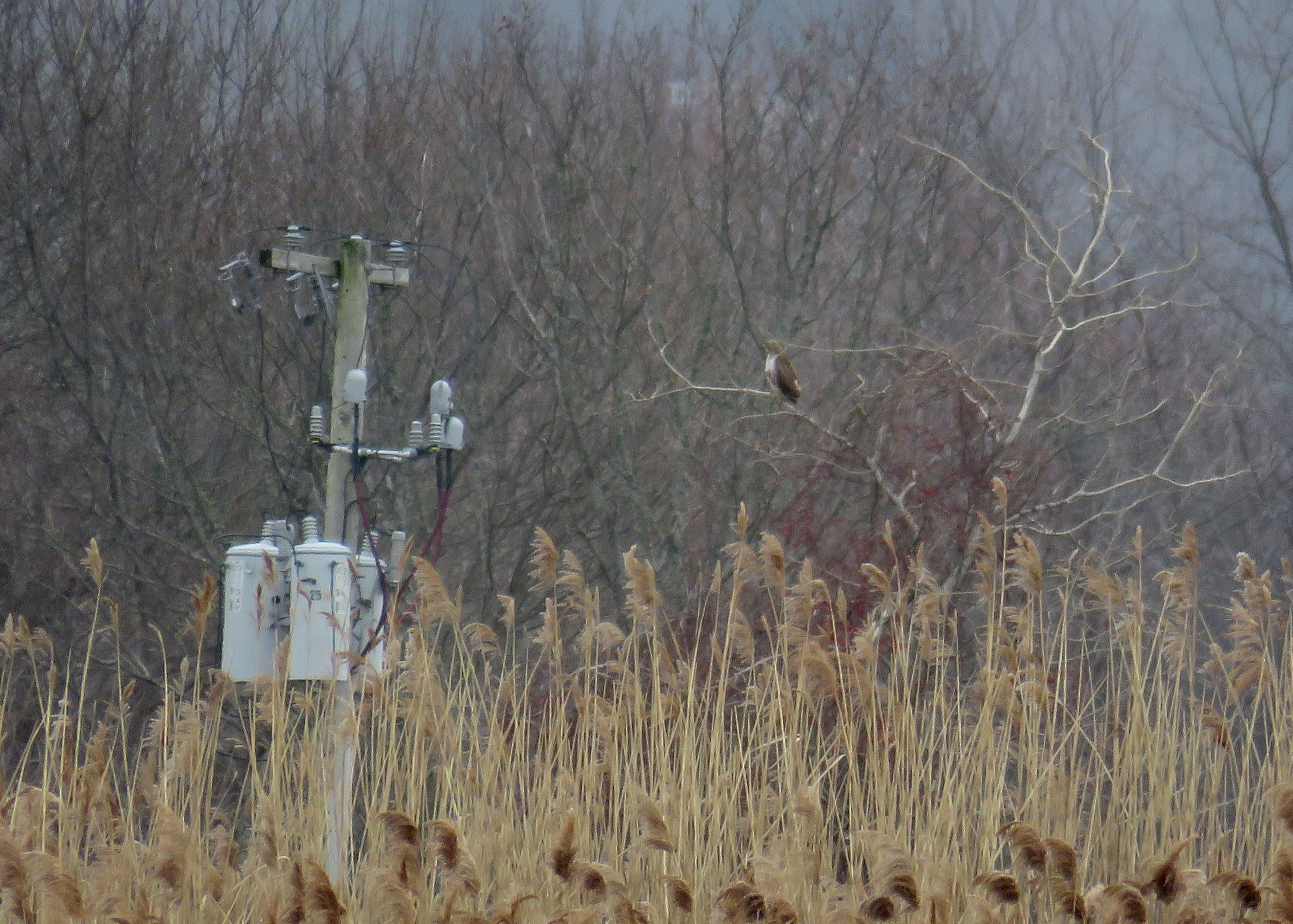
Red-tailed Hawk, Town Pond, Portsmouth, RI

Red-throated Loon, Town Pond, Portsmouth

American Wigeons, Town Pond, Portsmouth

While Aquidneck Island was never attacked during King Philip’s War, our birding adventure brought us near many locations associated with the war.

Tuesday, January 28, 2025

I Got a Pig: Reflections From the Cutting Edge of Cardiac Innovation [Redux January 2025]

(Source: Heartvalvesurgery.com)

A cat will look down to a man. A dog will look up to a man. But a pig will look you straight in the eye and see his equal.” -- Winston Churchill

Of all the innovations I've been exposed to through the years, from TempTales and modern air conditioning to cotton gins and Hamilton, the one closest to my heart is the 23MM Epic Supravalve. 

Six months Four years ago today, surgeons at Beth Israel Deaconess in Boston cracked open my chest, switched on their magic heart-lung machine, cut out my wonky, calcified aortic valve, and sutured in a new, porcine Epic Supravalve.

In another place or time, I might have received a bovine valve, or even one taken from a cadaver. Was I a little younger, I might have chosen a valve made out of carbon. 

But as it happened, on January 28, 2021, lying on an operating table not far from Fenway Park, I got a pig. I'm delighted to report, after a first year of up-and-down healing, there has been barely an oink. Thank you Beth Israel. Thank you Metoprolol.

Tuesday, January 14, 2025

Birding the Randall Davey National Audubon Center and Sanctuary: A Haiku Adventure

One of the treats of our Mass Audubon excursion to New Mexico was the opportunity to bird the Randall Davey National Audubon Sanctuary in Santa Fe. It was a chilly day with light snow, but we spotted 14 species, including the Juniper Titmouse, which was new to me. (While I only got a quick look and no picture, the Juniper Titmouse is a drab, plain gray bird whose reputation is its attitude, not its flashy looks.)

Better still, I knew nothing about Randall Davey (1887–1964), an American artist and educator known for his contributions to early 20th-century American art, particularly in painting. Davey is celebrated for his work in portraiture, landscapes, and equestrian scenes. He is also celebrated for fostering a vibrant artistic community, which was key in establishing Santa Fe as an essential hub for artists and creatives in the early 20th century. His works are featured in major collections, including those of the Smithsonian American Art Museum and the Whitney Museum of American Art.

Randall Davey's "Great Big Canvas"

Davey was part of the American Modernist movement and studied under influential artists like Robert Henri, a leader of the Ashcan School. He exhibited widely across the United States. In 1919, Davey settled in Santa Fe, New Mexico, at the historic site of a former mill, which became both his home and studio. This location is the one we birded, the Randall Davey Audubon Center and Sanctuary.

One of the amusing features of this beautiful sanctuary is the so-called Haiku Trail, a series of short poems (not all 5-7-5, however) written by (what appear to be somewhat frustrated) birders like me--trying hard to keep pace with the real birders in our group. 

Some images of our day follow.


A Townsend's Solitaire, a member of the thrush family (think American Robin), braving the snow and cold. John Kirk Townsend (1809-1851) was an American naturalist, ornithologist, and collector. He was a member of the famous Wyeth Expedition to the Pacific Northwest in 1834. 

One of the poems that resonated with me

Monday, January 6, 2025

The Beaver Pond: A Poem About King Philip's War

I was surprised and delighted to receive a note from Benjamin Rozonoyer saying that he had been inspired by King Philip's War: The History and Legacy of America's Forgotten Conflict to write a poem about the war--"Ponder Assawompset"--in his new collection, The Beaver Pond.

Ben grew up in Boston in a family of immigrants from the former Soviet Union. He received a master's in computational linguistics from Brandeis University and is pursuing a PhD in computer science and machine learning at the University of Massachusetts, Amherst. He lives with his wife and daughter in Colorado, cultivating poems and taking in local landscapes. 


You can purchase a copy of The Beaver Pond from Darkly Bright Press here


You may recall that Assawompsett Pond in modern-day Lakeville is where John Sassamon was allegedly murdered in the winter of 1674/5. The trial, a kind of kangaroo court held in Plymouth, was an event that sparked King Philip's War.


Just south of Assawompsett Pond is the Royal Wampanoag Cemetery, a small, beautiful cemetery that is the final resting place for some of Massasoit's descendants.

Saturday, December 28, 2024

Ironworkers and Their Monuments (Not) in New England


My latest local history post went live yesterday on Old Colony History Museum's blog, here

It's all about the 90-foot, $100K+ monument to the Leonard family and their ironworks that never got built

It was a detective story for me, and I'm not sure I got it right. But I'm close, I hope.


James Leonard lived and worked in Taunton and Raynham, but his brother and other family members launched an ironworks, the Rowley Village Forge Site, in modern-day Boxford, near my home on the North Shore. 

I did a walking tour here.

Friday, July 5, 2024

My 13 Favorite Gravestones and Memorials

After researching local history and genealogy for 50 years, I have traipsed through a fair number of cemeteries. (See "I See Dead Entrepreneurs" about Mount Auburn, and "I See Dead Entrepreneurs: Dr. Augustin Thompson and Moxie.")

As I was death cleaning some of my 1,404 image folders the other day, I decided I had enough odds and ends to assemble a Top 13 Favorite Gravestones list.  

#13 The first chapter of Innovation on Tap featured Eli Whitney, whose beautiful tombstone sits in Yale’s Grove Street Cemetery.

Most people know Whitney for this cotton gin and his firearms factory, but I covered his most remarkable achievement in a 2013 post, “Not for the Squeamish: Eli Whitney’s Greatest Innovation.”


What makes the Grove Street Cemetery fascinating is the number of American innovators buried so closely to Whitney.


Thursday, May 16, 2024

Sell Out and Become a Regular Man

I am reposting this May 2012 article about "The Ice King" after visiting with cousins last weekend and being treated to a bird's-eye view of Spy Pond in Arlington, one of Frederic Tudor's "ice factories." (Pictures below.) Tudor was booted from "Innovation on Tap" for length--my bad for writing 600 pages when no publisher wanted to see more than 280--but, author's foibles aside, he remains one of the most fascinating innovators of his time.

++++++++++++++++++++++++++++

Frederic Tudor was born in Boston on the day the peace treaty ending the American Revolution was signed in 1783. He rode the earliest wave of American entrepreneurial activity, becoming one of the country’s first millionaires.  

Tudor possessed all of the qualities we have come to treasure (for better or worse) in our entrepreneurs, being described as “defiant. . .sometimes reckless in spirit. . .imperious, vain, contemptuous of competitors, and implacable to enemies.  While energetic in competition, he preferred legalized monopoly.”

What really made Tudor successful, however, was his incredible, ungodly persistence. 

At a time when Americans joked that New England had just two crops, ice, and granite, Frederic Turner took the former and turned it into a multimillion-dollar industry, creating a precious luxury item in markets from New Orleans to Havana to Calcutta.  He saw a market that was simply invisible to his fellow merchants, and he built that market by teaching people how to carry, store, and use ice to preserve foods, cool drinks, and make ice cream.  

We know Tudor was an entrepreneur because his fellow Boston merchants--who were happy to speculate in everything from coffee to mahogany to umbrellas--thought he was just plain nuts.  When he invested $10,000 in 1806 and filled the good ship Favorite with huge blocks of ice hacked from Fresh Pond in Cambridge, the Boston Gazette wrote, “No joke.  A vessel with a cargo of 80 tons of Ice has cleared out from this port for Martinique.  We hope this will not prove to be a slippery speculation.” 


Much to the delight of his skeptics, this first trip turned out to be a financial disaster.  While much of the ice miraculously made it to Martinique, Tudor lacked infrastructure (namely, an ice house) and consumer education (how to use something that had never before been seen), so the ice melted away in six weeks, and he lost $4000.  (The solution to insulation would prove to be sawdust, creating an important aftermarket for New England sawmills.)

Spy Pond, Arlington, 1852


Spy Pond, Arlington, May 2024 (from the bee-keeping meadow :)


Sunday, October 8, 2023

Tweets for Tweets (7): My Favorite Bird Photos July 2022- Early October 2023

It's been a busy 12 months as we head into the 2023 holiday season, and this blog suffered the consequences. Not that I've been lazy, mind you. Just a little distracted.

I've worked on several white paper topics for Carrier, including a celebration of the 100th anniversary of the centrifugal chiller. Carrier is 120 years old and reinventing itself, which is a fascinating process to watch (and cheer on).

I've also been writing for the Old Colony Historical Society blog. Articles include: 

I also got to be an early reader of Bill Hanna and Katie MacDonald's nearly-published book, a fascinating history of the Taunton River. It's a work of art, and I have yet to see all the archival pictures in the completed book.

Both King Philip's War and Innovation on Tap book talks and speaking engagements have picked up, and that's been fun. 

I've also been writing bunches of essays for our Family Tree Maker database, and one in particular to my family that summarizes fifty years of genealogical research. 

I started essays on the Boxford match factory and researched ideas for three possible books, none of which panned out--but it was good work.

Oh--- I almost forgot. :) We were blessed with our first grandson, Theodore Schultz Lindquist. I have re-learned my Raffi lyrics, how to change a diaper, and where the best swings are located. It's. been. the. greatest. thing. since. the 1990s. I haven't taken Theo to Anawan Rock yet, or told him about Willis Carrier's "Rational Psychrometric Formulae" or the mistake Eli Whitney made in his cotton gin business plan, but soon. However, I did build few books for him on Shutterfly, including one to prepare him for birding.

My pig continues to behave. I even met a gentleman on my last Mass Audubon trip who had a porcine valve inserted in 2008 (thirteen years before me), and he thinks he's got another five years before the pig konks out. I was hoping for a decade of steady oinks, so that news was very, very encouraging.

Our couples book club passed 22 years and 162 books, with Barbara Kingsolver's Demon Copperhead becoming one of my all-time favorites.

As for birding, I've hit the usual local hotspots, running my life list up to 725 species. I also 

  • Traveled to Block Island with Mass Audubon earlier this month, adding a Buff-breastedSandpiper and a Clay-colored Sparrow
  • Birded a little on Star Island (Isle of Shoals) as part of a King Philip's War book talk, getting to spend time with one of my favorite archaeologists and historians, Dr. Emerson Baker
  • Bay View, August 2023, one of the
    best handbell concerts all year
    Visited Rocky Mountain National Park last summer (while babysitting for a Taylor Swift concert) and was lucky to add a Violet-green Swallow, Mountain Chickadee, Pygmy Nuthatch, Mountain Bluebird, Western Tanager, Spotted Towhee, Black-chinned Hummingbird, and a Broad-tailed Hummingbird. That collection is big-time stuff for an Easterner!
  • Birded around Bay View in Petoskey, Michigan (though I am habitually three weeks late visiting Hartwick Pines to see a Kirtland Warbler), while my lovely and talented wife played handbells
  • And birded the Finger Lakes (including Montezuma, where we spotted a Trumpeter Swan) with a visit to Cornell's birding center last November.

Here are some of my favorite bird photos taken during that period. First, from the aforementioned Finger Lakes:


Sunday, March 19, 2023

After This, Nothing Will Be the Same (Dick Fosbury RIP)

I first posted this piece on March 15, 2020. We lost Dick Fosbury recently, so I am reposting in his honor. There are very few "singularities" in sports, a moment when there is a clear before and after. Babe Ruth's home runs. Seth Curry's 3-point shooting. Dick Fosbury's Flop. RIP.

Remember Dick Fosbury? In 1967 he was ranked the 61st best high-jumper in the world. At the Olympics in Mexico City the following year, he cleared the bar at 7 feet 4.25 inches and won the gold medal.

He did it with a style so different from the traditional "western straddle" that it came to be called the Fosbury Flop. People laughed. Coaches watched in disbelief. One newspaper described it as going over the bar "like a guy being pushed out of a 30-story window."

Today, you cannot find a world-class high jumper who doesn't do the Fosbury Flop. One moment it was one thing; the next, it would never be the same.


Monday, March 6, 2023

New Local History Posts for Old Colony Historical Museum

For local history fans, I have six articles posted on Old Colony's "Medium" site, which (I think and hope) can be easily accessed. 

The first, posted in July 2022, is The Golden Age of Radio in the Old Colony (Three Acts). Not only is it a fun re-telling of the roots of commercial radio in the United States, but it's also a shout-out to my Uncle Eddie Litchfield, who was the voice of WPEP for 40 years. 

The second article, posted in August 2022, is The Authors of the Old Colony: A Summer Reading List (If You Dare). I don't usually traffic in listicles so thought I'd try my hand. The line-up includes a little history, a little poetry, some biography, and even true crime. (What says summer reading like Lizzie Borden and forty whacks?)

The third post, from October 2022, is Loves Me Like a Rock: Eight Old Colony Hunks You Should Know. Counting backward, #3 is Anawan Rock and #2 Dighton Rock. I'll let you guess #1.

Uncle Charlie's First Parish Church (1926)
in Framingham, MA

In December 2022, Old Colony posted Charles Monroe Baker: Taunton's Architect of Large Buildings. My great Uncle Charlie died before I was born, but he left a legacy of beautiful buildings all over eastern Massachusetts. My grandmother told me once that "Uncle Charlie was not a true Baker, as he always tried to preserve the amenities." I'll leave the implications of that comment to your imagination.

My two most recent posts are the first two parts of a three-part series called Fire and Ice: Some Calamities of the Old Colony. Part one is all about famous fires, including Brockton's Strand Theatre Fire and the Myles Standish State Forest Fire in 1964. Part two focuses on famous snowstorms, including the Blizzard of '78.

As you browse other Old Colony posts on Medium, you'll find all kinds of interesting history articles from Katie MacDonald (on how museums can be redefined in the 21st century) and Dr. William Hanna, including one on local Nike Missle sites, the death of Elizabeth McKinstry (at the future St. Thomas rectory), and the Reverend Samuel Hopkins Emery, who was born in Boxford but made his name in Taunton.

Sunday, March 5, 2023

The Day Music Was Invented: April 4, 1969

It's the 50th anniversary of a string of albums that have made up about half of my listening over the last 50 years. I doubt that fact reflects well on me, but I don't care. I'm now at a place in life where an artist can receive a Grammy for "Lifetime Achievement," and I have not heard any of his or her music. Not a song. Can you hear me, Dr. Wu? I. don't. care. :) Forthwith, my tongue-in-cheek tribute to the music of my life.

+++++++++++++++++++++++

Nothing much had happened in the music world before the spring of 1969. 

A bunch of guys with long hair fiddled around with harpsichords sometime between Rome and the steam engine. And then a bunch of guys with beards fiddled around with saxophones. I think some guys with guitars sang. Something like that.

Anyway, music was invented on April 4, 1969 when a band called the Chicago Transit Authority released its first album.

There followed a flood that barely lasted a decade. Nothing much has happened since 1979—since September 24, 1979, to be exact, when the Eagles released The Long Run.

Sunday, February 19, 2023

Gone But Not Forgotten: Dave Rossi (1957-2003)

Our baby with her godfather (Jan 1996)
We lost David Rossi 20 years ago today. It's a good time to crank up the Isaac Payton Sweat.

Dave grew up outside Pittsburgh and studied Chemistry at the University of Pittsburgh. His name is inscribed in the Omicron Delta Kappa Walk, a stone path between the Cathedral of Learning and Heinz Chapel, in honor of being named Senior of the Year in 1979.

I had the great misfortune to meet Dave when Pitt won the national championship, the Pirates won the World Series, and the Steelers won the Super Bowl. All at once. He was humble and softspoken, but not about his "City of Champions."

We roomed together in Brooklyn Heights, and both worked our first "real" jobs for the Chase Manhattan Bank, taking the subway each morning under the East River to the basement of Chase Manhattan Plaza. Our training floor included 200 recent college grads from all over the country, and we fell in with a great group of friends whose mission was to discover Manhattan. 

Since many of our colleagues lived on the Upper West Side, Dave decided that he and I had to purchase "crazy hats" so we could ride the 7th Avenue Line without trouble in the wee hours of the morning back to Brooklyn Heights. "Wear it low, look crazy, and never make eye contact," he told me. Good advice.

We thought it would be fun to celebrate New Year's Eve 1980 in Times Square. We donned our crazy hats and headed into (what was then) a cesspool, watching as a gang of thugs at the edge of Dick Clark's Rockin' New Year's Eve television lights cornered people and stole their wallets. Interested only in cash, the gang grabbed the bills and dumped each wallet in the trash. Dave and I went fishing, and on the morning of January 3, 1981, we mailed 15 wallets full of driver's licenses and credit cards back to their owners all around the country. 

Dave invited me home the first Thanksgiving we roomed to meet his family. His mother served a vast, delicious Italian meal, and I remember thinking, "This is nice but unusual for Thanksgiving."  Then Dave's mom cleared the table and served an entire traditional Thanksgiving turkey meal. He just looked at me and said, "Now you know why I have trouble losing weight."

I roomed with Dave during our first year at Harvard Business School. He introduced me to the HP-12C, chocolate-covered pretzels, and Cotton Eye Joe. He convinced me that Harry Truman was the only person in history who could have taken over the world. Based on his obsession with Louis L'Amour novels, he warned me never to carry a knife unless I was prepared to use it. More good advice.

Dave was the best man at Sue and my wedding in 1984 and godfather to our Emily.

A frozen moment, frozen in time
In the time I knew David Rossi, all he ever really wanted to do was go into space. He might have been an astronaut, except for his poor eyesight. Between senior positions at Spacehab and Orbital Sciences, he got close. Even when the Space Shuttle Columbia disintegrated as Dave lay dying of cancer, he never lost his optimism or passion for the final frontier.

At Dave's funeral in Washington, D.C., six of us were asked to speak.  

As we chatted beforehand, I realized we all believed the same thing: David Rossi was our best friend.

We were all correct.

Only the good die young. 20 years ago and still with us. Rest in peace, my friend.