Thursday, January 12, 2017

Reframing the Question

An excellent article in the recent HBR by Thomas Wedell-Wedellsborg  (“How Good Is Your Company At Problem Solving?”) surfaced a problem that faces some of the most aggressive,  get-it-done entrepreneurs: They don't spend enough time framing the question before they rush in to solve it.

Here' how it works:  You own an office building.  Your tenants are complaining that the elevator is too slow. 
How do you solve the problem?

One perfectly good way is to upgrade the elevator or install a new one, making the elevator faster.

Another—and this is genius—it to put mirrors up around the elevator, which causes people to stare at themselves, an infinitely interesting activity.  People stop complaining.  The elevator is no faster, but the problem has been reframed from “How do we speed up the elevator?” to “How do we make the wait more pleasant?”

Wednesday, January 4, 2017

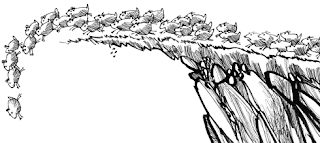
Some Say Icebergs, With Apologies to Robert Frost (A Bauble)

Some say the world will end in fire,
Some say in ice.
Yet as for ocean ships that ply
On frigid seas where icebergs lie
If we insist they perish twice
I think we know enough of steam
To say that for destruction fire
Is also great
And plenty dire.


Tuesday, December 20, 2016

Another Very Hot Year: Things I Learned in 2016

Another year, another hot one.

In fact, it was a record year for global heat, by a significant margin.  This follows the hottest five-year period on record.  As I write this, the North Pole is 50F above normal.  In the Antarctic, C02 levels hit 400 parts-per-million for the first time in four million years.  For those of you just joining us, welcome to the New Anthropocene.

America's President-elect signed a public letter in 2009 calling for cuts to America's greenhouse-gas emissions.  Three years later, he dismissed climate change as a Chinese hoax.  When he needed votes he promised to withdraw from the Paris climate agreement.  After he was elected he admitted to "some connectivity" between climate change and human activity. And then there was the wall he wanted to build at his luxury resort in Ireland to protect his property from the impact of climate change. More recently, a Trump transition official said that the new President might try to eliminate NASA's Earth Sciences department.  And the President-elect in December said, "Look, I'm somebody that gets it, and nobody really knows.  It's not something that's so hard and fast."  (More on this insane flip-flopping is here.)

Imagine a cabinet where the only official who admits that human beings contribute to climate change is the former head of ExxonMobil.  You cannot make this stuff up.  (Seth Meyers has a good piece here.) In the end, The Huffington Post wrote, "It's hard to overstate how anti-environment Donald Trump's cabinet picks are."

So, to begin 2017, we've got that going for us.

Monday, November 21, 2016

Show Me Your Leader And You Have Bared Your Soul

A friend of mine who works in non-profit fundraising says the best way to learn about a person is to ask about his or her top three charities.  Once someone reveals where they freely and enthusiastically give their money, you can quickly understand what makes them tick.

Pulitzer Prize-winning historian Gary Wills has another way of sizing up people. "Show me your leader," Wills wrote in Certain Trumpets," and you have bared your soul."

Willis offered his book about leadership in 1994, a year brimming with leadership advice. John Maxwell offered Developing the Leader Within You and Leadership 101. Stephen Covey was flogging Principle-Centered Leadership. Max DePree's Leadership As An Art was selling well.  Warren Bennis's On Becoming a Leader drew on hundreds of interviews to try to define the inner qualities of leadership.  And, after 450 years, Machiavelli's The Prince--"it is much safer to be feared than loved"--still had its enthusiastic disciples.

Wills boiled the existing literature down to the description of two types of leaders.  The first was the "superior-person" model which said the leader must become worthy of being followed.  The second was the "ingratiating" leader who treated followers as customers that must be won and influenced.  "We have long lists of the leader's requisites," Wills wrote, including  "determination, focus, a clear goal, a sense of priorities, and so on. We easily forget the first and all-encompassing need.  The leader most needs followers."

Friday, October 7, 2016

Spitting Bullets: An Interview with Malthus

Thomas Robert Malthus (1766-1834)  He's smiling.
Me: Are you smiling?

Malthus: I am.  That’s as good as it gets for an eighteenth-century English cleric.[1]  Anyway, I’m ahead.  Winning big time.

Me: How so?

Malthus: You know.  Population.  Food.  Everyone talks about my famous quote: “The power of population is indefinitely greater than the power in the earth to produce subsistence for man.”  A beautiful quote.  The best quote ever.  Believe me.

And for a long time I was feared.  “Malthus,” they would say, “he was right.”  Get to Broadway much?  Ever see Urinetown, when they all shout “Hail Malthus!”?  That felt good.  Maybe my finest moment.  Everyone on stage is dying and they think of me. 

Sometimes I hum the soundtrack to myself.  Gets me through the last fifteen minutes of morning prayer. 

Anyway, 25 million people died of famine in the nineteenth century.  Sixty million in the twentieth.  Right in line with my calculations.

And then along came Norman Borlaug and his Green Revolution.

Me: Missed that one, didn’t you?